The Petržalka tram celebrates one year in full operation, it has changed Petržalka with waiting times on the same level as a metro
27. 07. 2026
7 minutes read
Bratislava, 27 July 2026 – Even though the first trams returned to Petržalka ten years ago, Dopravný podnik Bratislava (Bratislava Transport Company, DPB) is today assessing the first year of full-fledged operation on the entire route. The new radial has transported as many as 1.2 million passengers per month (40,000 per day), which makes tram line 3 the city’s busiest line. Passenger traffic over the Danube bridges has also increased by 7% year-on-year. This confirms that the supporting rail system is crucial for Bratislava. DPB is now ready to follow up on this growing interest with further modernisation of the fleet and its lines, so that passengers have access to increasingly faster, more capacious and more comfortable transport.
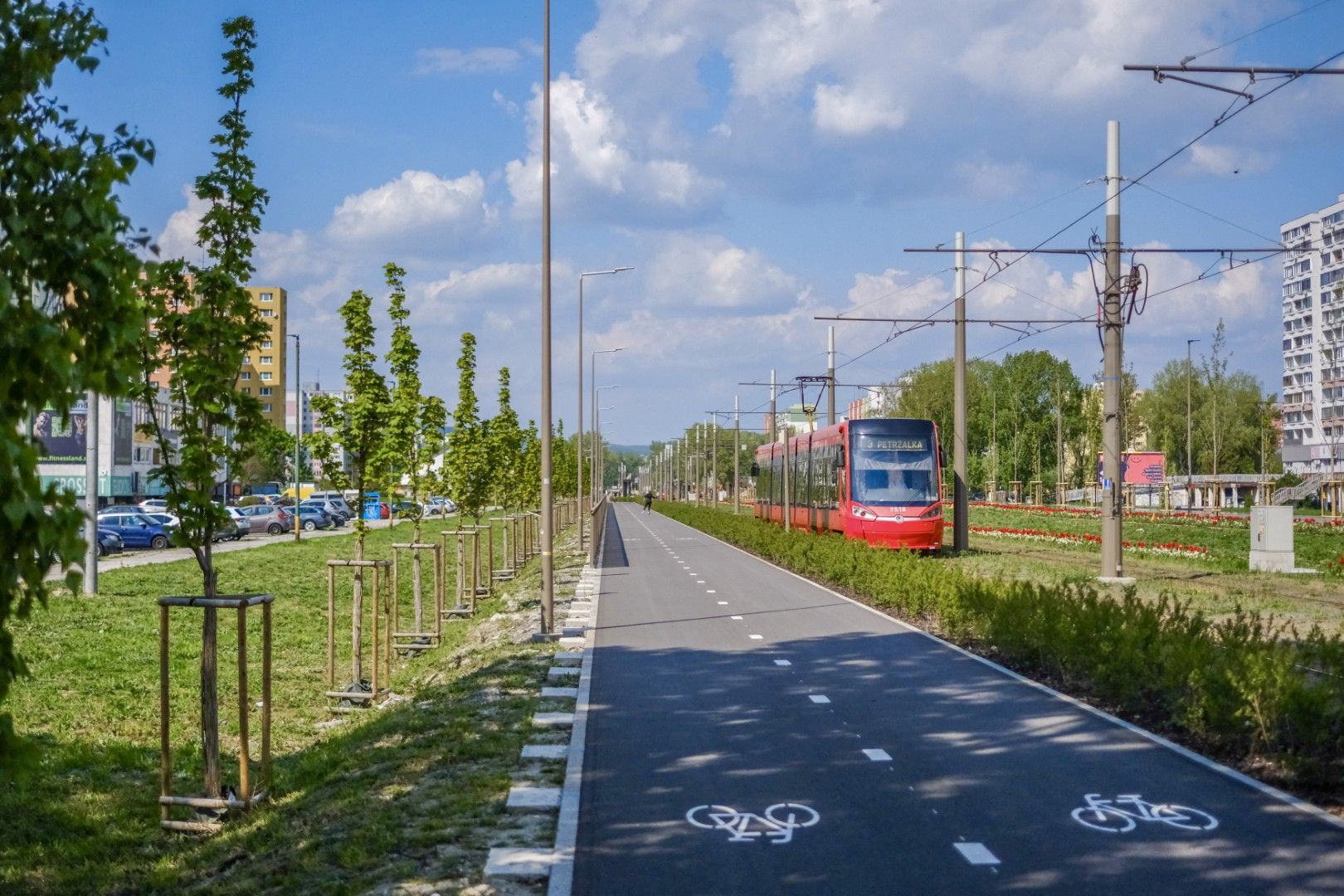
The new 3.9-kilometre tram line in Petržalka has brought 7 new stops, 4 bridges and 11 intersections, and almost 500 connections run along this route every day. The journey from the end of Petržalka directly to the city centre takes exactly 12 minutes and 45 seconds, and in the opposite direction, from the centre to the south of the housing estate, just 11 minutes and 30 seconds. The unrivalled times are not only the result of the line itself, but mainly to intelligent traffic management. Namely, trams have a set priority and receive an automatic “green” at intersections along the entire route.
Said the mayor of the capital of the Slovak Republic, Bratislava, Matúš Vallo:
“I’m really pleased with how the tram has changed Petržalka, how quickly the people of Petržalka have grown to love it, and how it has become a natural part of their lives. I remember how at the start of its construction some concerns were raised that the tram line would divide Petržalka. However, one year after the tram was launched, we see that the opposite has happened – the tram in fact connects. Not only has it connected both banks of the Danube, but thanks to it we have also built new bridges, pavements and intersections that have better connected Petržalka and made it easier for the people of Petržalka to move around this largest housing estate in Slovakia."
The new line has brought change to Petržalka as a whole
Data on transport across Bratislava’s bridges clearly show that the people of Petržalka have started to travel differently. The share crossing over the Starý most, which is used exclusively by trams, in the total use of bridges by public transport rose year-on-year from 19% to a fantastic 34%, which means it has almost doubled (+86%). On the other hand, the tram has taken a large number of passengers from buses (-13%), particularly from the Most SNP, whose share of transport has fallen from a dominant 50% to 40%.
The figures also revealed one interesting fact about the travel behaviour of Petržalka residents: while they use buses more often in the morning (to travel across the Most SNP and then continue on foot “down the hill” into the city centre), in the afternoon they return home from work by taking the tram across the Starý most, which comfortably bypasses all the afternoon traffic jams. This is how one in five Petržalka resident travels (19%).
Says Martin Rybanský, Chairman of the Board of Directors of DPB:
“The connection of the entire route has also attracted new passengers, with boardings on the “old” part of the line rising by more than a quarter year-on-year. The tram likewise as created full-fledged local transport, since up to 40% of trips are made exclusively within Petržalka. It has thus become a true artery linking different parts of the largest housing estate. The unique 2-minute interval during the morning rush hour has also contribute to its popularity. This means an average waiting time of 60 seconds for a connection, which brings us to the parameters of a metro."
At the same time, trams have largely replaced buses in Petržalka, thus saving 454 tonnes of greenhouse gases per year (CO2e) and removing 1.5 tonnes of nitrogen oxides or 13 kilograms of dust particles from Bratislava’s air.
Adds Martin Rybanský:
“While a year ago, only one in five Petržalka residents travelled across the Danube in an emission-free manner (by tram), after a year of operation of the new line, the number is already one in three."
Bratislava trams: a city-forming replacement for a metro system
Trams are and will be the key to rapid transport in the city, but they need systematic investment. An example is the successful modernisation of the Dúbravsko-Karloveská radial as well as the Vajnorská radial from Zlaté piesky to Tomášikova ulica, which led to the removal of noisy panels, significantly quieter driving and the construction of modern barrier-free stops. The line today is even the only one in Slovakia certified for testing vehicles at speeds of up to 80 km/h.
The opening of the renovated Krasňany Depot was also a huge step towards reliable operation. DPB turned a worn-out, 50-year-old area into a modern and ecological depot with a new washing line, a green roof and 4,200 metres of completely new tracks, which will bring the company long-term savings in operating costs.
Says Martin Rybanský:
“The demand for urban public transport is growing at a significant pace – in 2025, the company transported almost 300 million passengers, which is more than in the pre-pandemic year of 2019. To maintain demand, DPB has prepared a number of projects in the immediate implementation stage worth over 771 million euros. Our aim is to fully utilise the potential that rail transport offers Bratislava."
If the necessary funds are released by the state, Bratislava will see another significant leap in the quality of public transport. The projects count on the purchase of 60 brand new, almost 50-metre mega trams with a capacity for at least 345 passengers, which would allow all the old vehicles to be replaced. This would bring more seats for passengers on both the Račianska and Petržalska radials. It would also be possible to move forward on the reconstruction of worn-out lines, which would shorten travel times and increase reliability and safety for passengers.
Concluded the Mayor of Bratislava, Matúš Vallo:
“We have invested a great deal of effort and money in public transport, and I’m glad the citizens of Bratislava also appreciate the growing quality of our public transport. At the same time, I’m convinced that public transport is one of those areas in which Bratislava can outperform the cities around us, which we have looked up to for a long time. We have clearly set goals for the future in this regard, and I believe that we will be able to continue working to achieve them."
Dopravný podnik Bratislava
DPB is the largest urban transport company in Slovakia. In recent years, it has carried out an extremely extensive qualitative transformation, due in part to its own successful projects worth 300 million euros from EU funds. Pure electric traction (trams, trolleybuses, electric buses and hydrogen buses) today provides up to 45% of total transport performance within the capital.
Since 2019, thanks to the continuous and systematic purchase of almost 400 new vehicles, DPB has completely replaced 75% of its daily journeys on the streets of Bratislava. At the same time, it has systematically increased the capacity of connections by purchasing unique 24-metre MEGA trolleybuses. With the goal of reducing emissions in the city, the company has also included modern hydrogen buses in its fleet and has made selected bus lines green by deploying hybrid trolleybuses. In 2026, DPB is carrying out a massive renewal of its bus fleet, in the course of which as many as 126 new buses will be added to Bratislava’s roads. As a result, the average age of the city’s buses will fall from almost 9 years to under 6 years.
Effective management of DPB since 2019 has brought savings of over 60 million euros, and this has translated into a huge increase in trust – in a local survey, the overall satisfaction of residents with DPB services reached a historic high of 90.1%. The objective quality of services was also confirmed by an independent audit of the European Commission (Quality of Life), in which Bratislava recorded an overall increase in satisfaction with public transport by 7 percentage points, thanks to which Dopravný podnik Bratislava became the transport company with the biggest leap forward among the 83 evaluated metropolises.